Why Does My Productivity Only Explode Before Deadlines?
Your Brain Has Been Trained to Be a Deadline Slave
Someone on Reddit asked a question that many freelancers secretly wonder about:
I've noticed a pattern I can't seem to break: I don't take action until the pressure is unbearable. If there's a deadline tomorrow, I can work like a machine. But when I have plenty of time? I freeze, overthink, avoid, and convince myself I'll 'start later.'
I don't want to keep living in constant last-minute adrenaline mode. It works, but it's draining, stressful, and honestly embarrassing sometimes. I want to learn how to start things earlier, not because I'm panicking, but because I choose to.
If this voice echoes in your mind, you're not alone. In fact, millions of knowledge workers, freelancers, and entrepreneurs find themselves trapped in this same cycle.
But this isn't a character flaw. It's how your brain has been trained to respond.
And most importantly: it can change.
Why Your Brain Needs Deadlines to Work
Brain Dependency on Deadlines: The Neurobiology Truth
To understand why you can't work during loose timeframes, you need to understand how your brain responds to time pressure.
When a deadline approaches, what happens? Your brain releases adrenaline and cortisol, which are stress hormones. You enter a "fight or flight" state. This physiological condition activates your sympathetic nervous system, causing:
- Blood flow concentrates in the brain and muscles
- Pupils dilate, narrowing your vision but sharpening focus
- Unnecessary functions pause (including social engagement, digestion, and others)
- Energy redirects to immediately available tasks
From an evolutionary perspective, this makes perfect sense. When a predator hunts you, you don't need to think much, you just run. Facing a deadline triggers this same biological system.
But here's the problem: your brain learned a harmful lesson.
Neuroscientists discovered that repeated experiences reshape neural pathways. Every time you work before a deadline, you reinforce those stress-related neural circuits. Meanwhile, the neural pathways for planning, starting, and sustaining work grow weaker.
Temporal Motivation Theory: Why Distance Equals No Motivation
A psychological theory explains your predicament: Temporal Motivation Theory.
According to this theory, your motivation for a task isn't fixed. It changes over time, following a predictable pattern. Expressed as an equation:
Motivation = Expectancy × Task Value ÷ (1 + Impulsivity × Delay)
In other words: when a task is far away, even if it has high value, your motivation remains low. But as the deadline approaches, motivation undergoes hyperbolic acceleration, meaning it grows in an accelerating fashion.
This explains why you can complete a month's worth of work in the final two weeks. Not because you suddenly became smarter or more capable, but because the time horizon changed your brain chemistry.
Effort Discounting: Why Waiting Feels Easier
Newer neuroscience research revealed a deeper mechanism: Effort Discounting.
A study published in Nature scanned people's brains and found this: procrastinators' brains excessively discount the effort cost of future tasks. In other words, their brains calculate work differently. If a task is due next week, their brain says: "That effort feels distant, I don't need to worry about it now."
But when the task is due tomorrow, effort gets reassessed as immediate, so the brain forces you to act right away.
This isn't laziness. It's a biological difference in time perception.
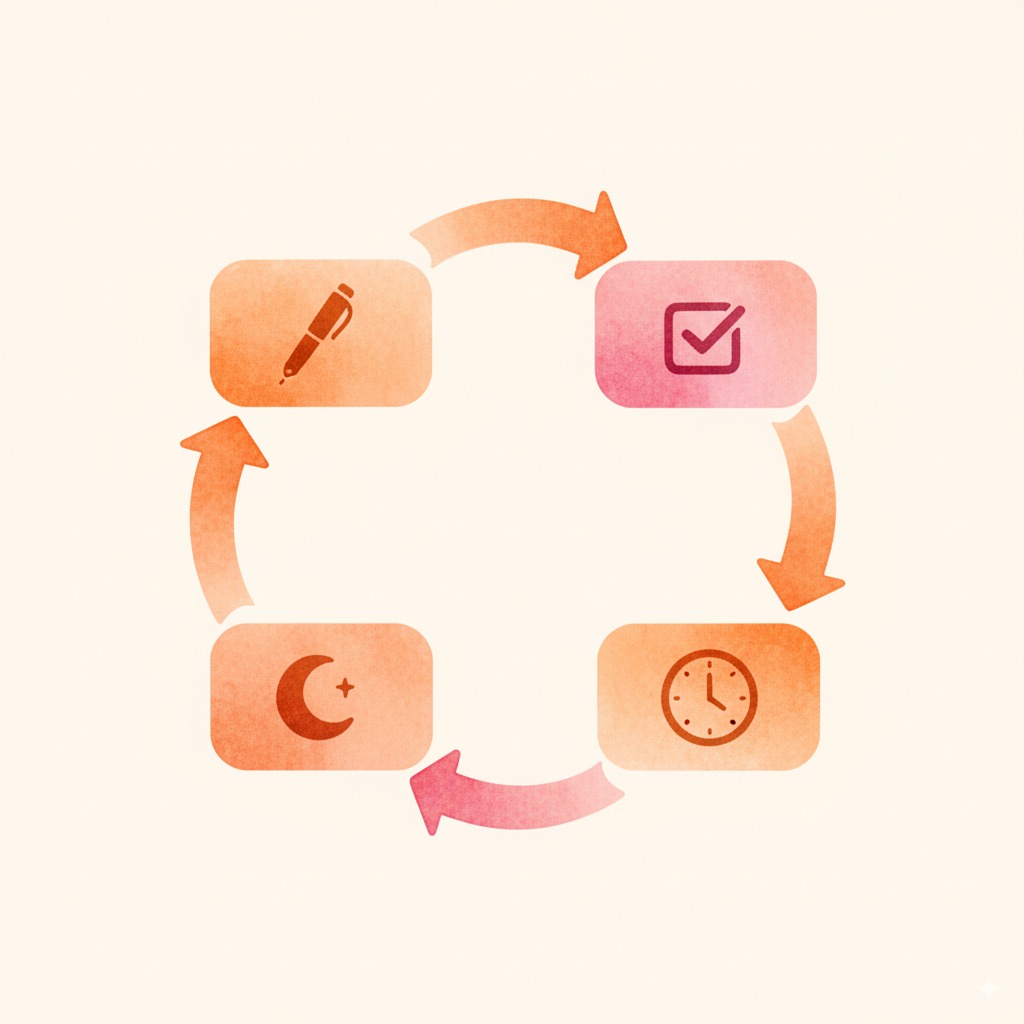
What's Actually Happening? The Rapid Cycle
Let's break down the cycle you actually experience and see how it becomes self-reinforcing:
Stage 1: Abundant Time (Lack of Motivation)
You have a project with a deadline a month away. Psychologically, this feels distant. Your brain says: "We have time."
Result? You don't act. You might think about it, plan it, but actually starting requires overcoming activation friction that feels too large for your motivation system.
Meanwhile, more pleasant activities, checking social media, doing other work tasks, or even organizing your desk, seem more appealing. Dopamine (immediate reward chemical) flows to these activities instead of your real work.
Stage 2: Starting Anxiety (Can't Act)
As time passes, you notice the deadline getting closer. Guilt begins to set in. Anxiety increases. But this anxiety actually increases procrastination.
Why? Because according to psychological research, anxiety activates the amygdala (emotional center), which drives avoidance behavior. Your brain says: "I should start, but this feels uncomfortable, so let me do something else to reduce this discomfort."
This is avoidance as a coping mechanism, temporarily effective but costly.
Stage 3: Deadline Explosion (Last-Minute Machine)
Suddenly, time runs out. Maybe 3 days remain, or 6 hours, or (sometimes) after submission.
Now the deadline's time distance has become zero. A switch flips in your brain.
Adrenaline spikes. Cortisol surges. Everything else gets ignored. You enter hyper-focus state, working like mad, completely focused on the current task.
Maybe the quality isn't perfect. Maybe you sleep poorly. But it gets done.
Stage 4: Brief Relief (Then Repeat)
After submission, there's a moment of relief. You did it. Stress suddenly dissipates.
Your brain calculates: "This works. Just wait until the deadline, and adrenaline will kick in."
So next time a task begins, your brain is already trained to expect the same pattern.
Why This Harms Your Body and Mind
It looks like procrastination "works," task gets completed, right?
But the cost is much higher.
Chronic Cortisol Damage
When you constantly live in cramming mode, you're continuously activating the "fight or flight" response. This means chronic cortisol elevation.
Cortisol at high levels causes:
- Damaged cognitive function: Long-term memory, focus, and learning ability all suffer
- Weakened immune system: You get sick more easily
- Triggered anxiety and depression: Cortisol alters serotonin and dopamine levels
- Increased fat storage: Especially in the abdomen
- Accelerated aging: At the cellular level
Neuroplasticity Working Against You
Neuroplasticity is the brain's ability to change and rewire itself, which is good unless you're reinforcing the wrong patterns.
Every time you work before a deadline, you strengthen those neural pathways. Every time you avoid work when you have time, you strengthen another set of pathways.
Over time, your brain becomes harder to activate for non-deadline work. Not because you've become lazier, but because your neural networks have been optimized to only function under high pressure.
Long-Term Mental Health Costs
Yes, last-minute work might complete the task, but it comes at the cost of constant stress, shame, and guilt.
Even after submission, many people report:
- Insomnia and sleep problems (from elevated cortisol)
- Anxiety that doesn't immediately disappear after the deadline
- Burnout spreading to other life areas
- Aversion to work (because work = suffering)
- Relationship stress (increased irritability toward family and friends)
Change Is Possible: The Hope of Neuroplasticity
Good news: if neuroplasticity trapped you in this pattern, it can also free you.
Neuroscientists tell us the brain can change, but it requires consistent new behavioral repetition and time. According to addiction recovery research, the most significant changes occur in the first two years, though the process is essentially lifelong.
This isn't a quick fix. It's gradually retraining your brain's response to work and motivation.
Strategy 1: Choose Challenges That Can't Be Crammed
First, actively design pressure, but differently.
Choose challenges requiring long-term progress, sign up for a marathon, commit to leading weekly book club discussions, or plan a month-long personal project.
Why it works?
Because you can't complete marathon training in the final week. You can't escape into cramming mode. Your brain gets forced to change tactics: from relying on single bursts to building daily and weekly habits.
According to sports psychology research, marathon training typically requires 16-20 weeks. Training feels difficult at first. But by week 8, you've invested time, energy, and social commitment. By weeks 12-16, self-efficacy rises and motivation strengthens. By the final 4 weeks, research shows motivation typically surges significantly, not because of external pressure but because of progress itself and internalized beliefs about capability.
This is where your brain gradually shifts from external pressure dependence to internal progress drive.
The key is choosing a challenge that truly matters to you in practice. Not because it looks good, but because you genuinely care about the outcome.
Strategy 2: Raise Task Difficulty to Awaken the Reward System
This sounds counterintuitive, but neuroscience shows: dopamine (the motivation chemical) increases with difficulty, not decreases.
If a task feels boring, it's probably too easy for you. When task difficulty matches your skill level (psychologists call this "flow state"), dopamine flows and you naturally enter focus.
If you find yourself unable to stop procrastinating, try deliberately raising difficulty:
- Shorten your allotted time (but not to emergency levels)
- Raise quality standards
- Add extra responsibilities or constraints
- Bind other people's interests or expectations
Your brain notices and responds. The challenge triggers dopamine release, making work more attractive.
Strategy 3: Bind Other People's Interests, the Strongest Lever
Let's discuss why "public commitment" often fails and why binding others' interests is far more powerful.
The Problem with Public Commitment:
You announce you'll complete a project in a month. Friends hear it. "Great," they say.
A month passes. You haven't completed it. You stay quiet. Your friends? They've already forgotten. Who really cares? Only you. And if you've decided to accept failure, there's no real social cost.
Why Binding Others' Interests Works Better:
Now consider a different scenario: you commit to performing guitar at a friend's wedding.
This isn't just "your project" anymore. An entire event depends on you. Guests are invited. There's a ceremony. There are expectations.
If you procrastinate, it's not because you disappointed yourself, it's because you disappointed a hundred people. Friends might even ask: "Have you been practicing?" Three months later, six weeks later, one week later. They won't let you forget.
Most importantly, it's not just about your sense of responsibility. There's also external pressure. Reminders. Expectations. This is completely different brain chemistry.
According to psychological research, when your actions directly affect others, completion rates increase significantly. Not because you're "more motivated." But because the cost of procrastination shifted from "I'll feel guilty" to "real people will face real consequences."
Practical Examples:
- Not Effective Enough: "I'll start my side project" → Three months pass with no progress, no one asks
- More Effective: "I'll lead weekly technical discussions for my team" → Colleagues depend on you. Insufficient preparation becomes obvious
- Most Effective: "I'll write an article for this month's company blog and share it in our community newsletter" → The editor expects it. Readers expect it. There's public accountability
The key difference is: your action directly connects to others' expectations.
Three Levels of Interest-Binding:
1. Dependency Level Someone depends on completing your task to complete their own work. Example: "I commit to finishing design review by Monday so developers can start coding."
Psychological cost: High. If you procrastinate, the entire team gets delayed.
2. Expectation Level You make a clear commitment to someone/a group who will regularly check progress. Example: "I tell my accountability partner my writing progress every week."
Psychological cost: Medium-High. They remember your commitment. They'll ask. No way to escape.
3. Event Level Your action connects to a specific, unmovable event. Example: "I perform guitar at my friend's wedding (the date is fixed)."
Psychological cost: Medium. Pressure comes from the date's inevitability rather than from people.
All three work, but they're most powerful when they overlap. The strongest scenario combines all three: someone depends on you (level 1), they regularly check in (level 2), and there's a fixed final event (level 3).
Strategy 4: Build "Artificial Deadlines" and Milestones
If your final deadline is a month away, don't wait a month to start.
Instead, create intermediate deadlines and milestones. Perhaps:
- Monday: Complete research (20% of total work)
- Wednesday: First draft (60%)
- Friday: Internal review (85%)
- Following Monday: Final version (100%)
These artificial deadlines frequently trigger temporal motivation theory effects. Your brain experiences small "deadline bursts" every few days instead of one massive burst.
Over time, the brain adapts to this distributed pressure rather than depending on a single peak.
More Powerful Method: Combine with Interest-Binding
What if you told your manager or colleagues about these intermediate deadlines? "Monday I complete research. Wednesday I give you a draft for review. Friday I finish."
Now intermediate milestones have witnesses. You can't silently miss them. This beats merely "committing to yourself."
Intrinsic vs. Extrinsic Motivation: Different Paths Forward
All the strategies above use external structure (deadlines, binding, milestones) to retrain your brain. This works because external pressure is currently your brain's language.
But ultimately, true freedom comes from building intrinsic motivation.
The Science of Intrinsic vs. Extrinsic Motivation
Extrinsic motivation is driven by external factors: deadlines, rewards, punishments, others' expectations. It works but brings stress and dependence.
Intrinsic motivation is driven by internal factors: genuine interest in the work itself, alignment with personal goals, joy in learning or creating. It's self-sustaining, requiring no continuous external push.
Research shows intrinsic motivation:
- Lasts longer (sustainable for years vs. collapses when rewards disappear)
- Produces higher quality (people think more carefully, innovate more)
- Reduces stress (no need for continuous external driving)
- Promotes learning (people understand material more deeply)
But here's a trap: external deadlines can actually damage intrinsic motivation.
If you work because of a deadline, that deadline becomes your reason. When the deadline disappears, so does motivation. This is clearly documented in research, external deadlines can reduce intrinsic interest in the task itself.
Transitioning to Intrinsic Motivation
So how do you move from "I must do this because of deadlines/others depend on it" to "I choose to do this because it matters to me"?
Three-Step Process:
Step One: Connect Tasks to Personal Values
Every job has some possibility of personal meaning. Not all work is exciting, but every job can connect to larger goals.
For example:
- Writing reports isn't exciting, but improving communication skills is
- Administrative work is boring, but organizing a learning system is interesting
- Code practice might feel repetitive, but creating tools that help others is satisfying
Take time to think: "What does this teach me? How does it connect to what I want to build? How does it help people I care about?"
Step Two: Seek Mastery, Not Completion
Intrinsic motivation is driven by autonomy, capability, and mastery. Mastery means seeing progress and improvement.
Rather than just "completing tasks," practice reflection:
- Did I do this better than last time?
- What did I learn?
- What do I want to improve?
This shifts your focus from external evaluation ("Did I finish on time?") to internal learning ("Did I improve?").
Step Three: Allow Autonomy and Control
Self-Determination Theory tells us humans need three things to feel motivated:
- Autonomy: The ability to choose how to do things
- Capability: The sense that success is possible
- Relatedness: Connection to others and purpose
You can't control all deadlines, but you can control:
- How you organize work
- The tools and processes you use
- Who you ask for help
- How you measure success
Giving yourself more "how to complete this" decision-making increases intrinsic investment.
Practical Action Plan: Start Changing
Now you understand why this happens and the theory of change. But real change happens through action.
Step 0: Diagnose Your Type
Not all procrastination is the same. Self-assess:
Are you a passive procrastinator?
- You often feel afraid or anxious about tasks
- You delay to escape discomfort
- Even when working, quality often falls short of your standards → Focus: Build psychological safety and confidence
Are you an active procrastinator?
- You know time management isn't great, but you accept it
- You deliberately delay to leverage pressure
- Under deadlines, you do your best work → Focus: Gradually build lower-pressure work habits
Are you a low-motivation procrastinator?
- Work feels meaningless to you
- Even dopamine doesn't drive you
- You feel motivation-deficient → Focus: Reconnect with genuine values
Step 1: Choose a Long-Term Challenge (1-2 months)
Select something meeting these criteria:
- Can't be crammed: A 16-week marathon, 30-day writing challenge, daily habit tracker
- Matters to you: Not because it looks good, but because the outcome personally matters
- Has visible progress: You see progress daily or weekly
Sign up. Tell at least 3 people.
Step 2: Create an "Internal Deadline System" for Your Most Important Work
Not one deadline, but distributed milestones:
For a month-long project:
- Week 1: Complete all research and planning (ensure you understand scope)
- Weeks 2-3: Initial draft or core work (60% complete)
- Week 4: Polish and finalize (final 30%)
- Final day of week 4: Submit
Small deadlines frequently trigger temporal motivation without creating last-second panic.
Step 3: Find Someone Whose Plans Your Progress Affects
This is the most critical step. Not just "going public." You need to bind their interests.
Options:
Option A: Dependency Binding (Most Powerful) "I commit to finishing design review by Wednesday so you can start development," your manager or colleague depends on your work completion to do theirs.
Cost of procrastination: Immediate and specific. They can't proceed.
Option B: Expectation Binding (Strong) "I'll report my progress to you every Friday," your partner expects weekly updates. No silently disappearing.
Cost of procrastination: Hard to explain why there's no progress. Regular check-ins.
Option C: Event Binding (Medium Strength) "I'll present results at next month's team meeting," there's a specific date and audience.
Cost of procrastination: Can't suddenly change the date. Everyone's watching.
Option D: Commitment Binding (Most Personal) "I'll perform guitar at my friend's wedding," "I'll lead weekly book club discussions," people depend on your participation or preparation.
Cost of procrastination: Directly disappointing specific people who care about you.
Pick what works for you. Ideally: your delay directly affects another person's plans or expectations. They'll remember. They might ask. No escape.
Step 4: Find Intrinsic Meaning in Your Work
For the work consuming most of your weekly hours, ask yourself:
- "What does this teach me?"
- "How does this help people I care about?"
- "How does this connect to my bigger goals?"
Write the answers. Save them. Re-read when motivation drops.
Step 5: Build a "Non-Deadline Daily"
Find something small you choose to do without external deadlines or rewards.
- 30 minutes daily learning a skill
- Writing a personal journal
- Doing something for loved ones
- Working on an open-ended project
This should be purely because you want to, nothing else. This trains your brain to work without pressure.
What to Expect: The Realistic Timeline
Rewiring your brain takes time. According to addiction recovery and neuroplasticity research, here's what's realistic:
Weeks 1-2
- Start feeling benefits from new strategies
- Impulses to fall back into old habits still arise
- Requires conscious effort, not automatic yet
Month 1-3
- Significant progress, new habits start feeling easier
- Working with milestones feels less painful
- Deadline bursts still happen but less frequently
Months 3-6
- New working methods increasingly automatic
- You start seeing intrinsic motivation rise
- Working without deadlines no longer feels completely counterintuitive
Months 6-12
- Most brain rewiring is happening
- You can now work without external pressure
- Deadline bursts occasionally happen but aren't your main work pattern
Year 1-2+
- New neural pathways strengthen and become default
- Old procrastination habits might still exist (triggered during stress) but get overwritten by new habits
- You've successfully retrained your brain
This isn't linear. There will be good weeks and difficult weeks. There will be moments returning to old patterns. But each time you choose new behavior, you strengthen those neural connections.
Your Brain Can Change
The procrastination cycle you're experiencing now feels unbreakable because it's deeply embedded in your neural structure. Years of practice optimized your brain to work only under high pressure.
But here's the good news: if your brain learned this pattern, it can unlearn it.
You don't need "more discipline" or "better willpower." You need:
- Understanding the mechanism (you have now)
- Changing your environment and structure (milestones, bound interests, intermediate deadlines)
- Time and consistency (new neural pathways need repetition until automatic)
- Gradual shift toward intrinsic motivation (moving beyond external pressure dependence)
Start small. Choose one strategy, maybe a long-term challenge or finding someone whose plans your progress affects. Practice it for a week. Notice what happens.
You're not trapped. Your brain simply learned a specific pattern. Changing that pattern is entirely possible.
Start today. Find someone whose plans your progress will affect. Tell them your plan. Your brain will feel confused, then it will start adapting. This time, you're controlling pressure instead of pressure controlling you.
About Time Management Now
If you recognize yourself in any of the above, Orlo was built exactly for this.
Orlo isn't another task management app. It's an AI-powered time management and scheduling assistant designed to help people exactly like you, those who can't work without deadlines.
How Orlo Works:
- Capture-to-task functionality: Quickly convert your thoughts into actionable work
- AI-powered scheduling: Orlo doesn't make you manually plan everything. It analyzes your time and commitments, then suggests the most optimized schedule
- Morning briefing/kickoff: Start each day already knowing what to do, why it matters, and how it fits your day
- Goal tracking and milestone rewards: See progress, get immediate feedback on small wins
- Time-boxing system: Break work into manageable chunks, building intrinsic rhythm
- End-of-day reflection ritual: Each day's end, reflect on what you did and what you learned
- Progress sharing and witnessing: Optionally share milestones with your team or partner, creating interest-binding structure
Basically, Orlo creates external structure and witnesses while you build new habits. Over time, your need for AI assistance decreases, but the habits you built remain.
Most importantly, Orlo recognizes: change doesn't happen from better intentions. Change happens at the intersection of environment, accountability, and witnessed progress.
If you're ready to escape deadline addiction, Orlo is here to help you do it.
Tags
Ready to optimize your time?
Transform these strategies into action with Orlo's AI-powered time management.
Get Started